
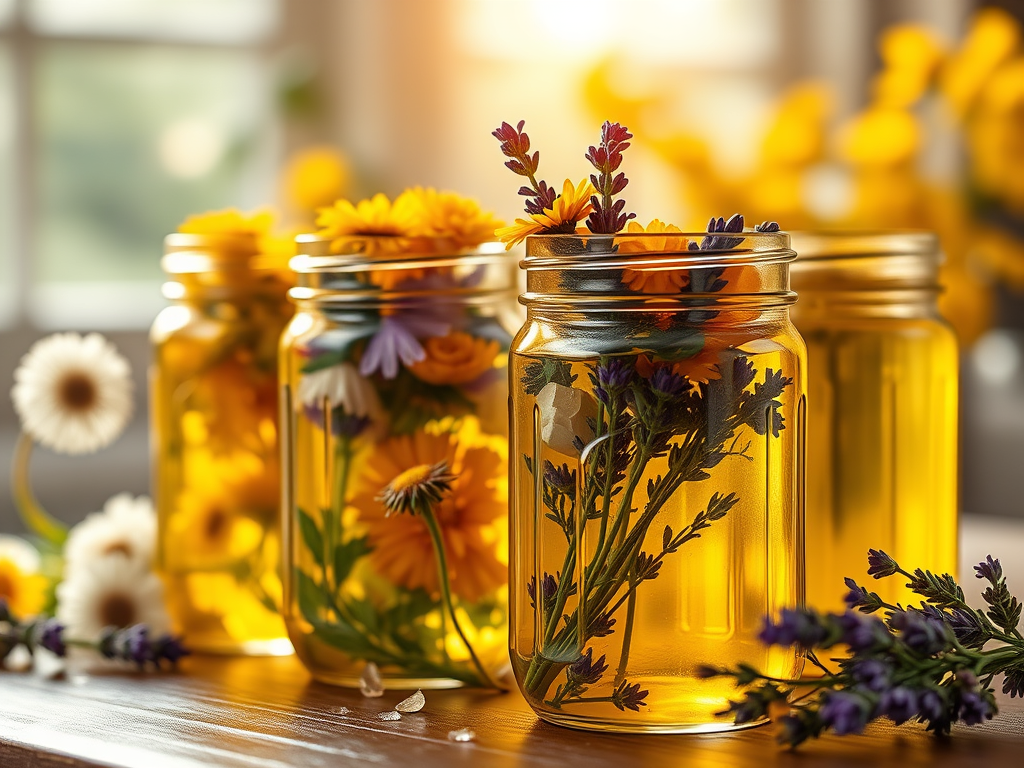
*Important note: Infuse dry herbs. Moisture in the plant parts will mold and contaminate the oil.
Infusing herbs in oil is a wonderful way to get them into your life. When you use the oils in salves, creams, or stand alone massage oils it benefits your skin and lets you express your creative side.
Choose a project
The possible combination of herbs and oils is almost unlimited. What is your intention? Do you want to make a salve that will loosen tight muscles? Are you trying to help dry skin be more moisturized? Are you looking for ideas for gift giving? There are herbs and oils for all of that.
Choose your herbs: A few herbs that have an affinity for your skin and are very easy to grow or source are dandelion flower, calendula flower, lavender flower. You can make a combination or infuse them separately. I prefer to make separate infusions so that I can watch the process of each one and use them later in other projects.
Choose your oil: I’m pretty simple. I have stuck to a few standard oils, organic olive oil and organic avocado oil. To learn more about oils check out The Lipid Academy. Susan and Olivia are such a treasure trove of knowledge. Their emails have more information than most articles and they offer free and paid courses.
Olive Oil is a common oil used for infusion. It is easy to find and relatively inexpensive. It contains antioxidants and is rich in Vitamins A & E. It has anti-inflammatory properties and may help heal skin. (Very Well Health) The downside is sometimes your skin is left with a greasy feeling.
Avocado Oil is an oil I recently decide to try. I have infused cottonwood buds, calendula, dandelion, and lavender. All were infused in the same avocado oil. Can you see the difference in color? That’s the power of the herb.


The Process
Fill your jar 1/3 to 1/2 of the way with your herb of choice. You will learn which herbs soak up more oil and can adjust the amount. ( Richo Cech teaches a standardized method which you will need if you want to sell your products. For personal use or gift giving, the home herbalist method is just fine. ) Pour your oil on top of the herb, cover tightly and shake. Label your jar with the herb, oil, and date. I have started adding how much of each I use for reference. Place the jar in a filtered sunny window or in a dark closet. Every herbalist does this differently. I like the sunny window. Shake the jar daily or as often as you remember. Let it do it’s thing for 4-6 weeks.
When the waiting time is over, strain the herb (marc) from the oil (solvent) using clean unbleached muslin, a tea towel, or an unbleached coffee filter will work in a pinch. I like to put the material into a strainer basket, put the basket on top of a funnel in a mason jar, and pour through there. Straining oils can get very messy.
Label your finished oil. You can add whatever information you think is important. For the finished product I add the herb, oil, and date. Plus I like to add what properties the oil is helpful with. Store in a cool dark place.
You are now ready to create your own products. I will cover some basic recipes in the next post. Be sure to sign up for notifications so you won’t miss out.
References:
https://lipidoils.com
https://www.verywellhealth.com/olive-oil-skin-benefits-5095861 https://strictlymedicinalseeds.com/books/


 Scented By Nature
Leave a comment