
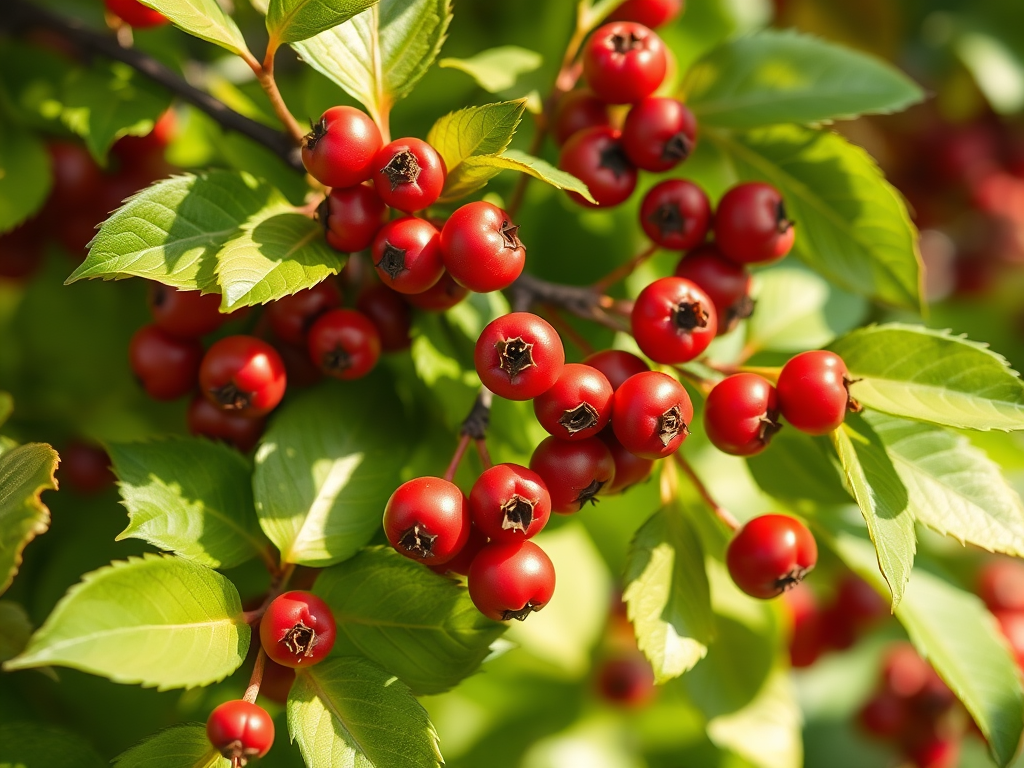
In While I Was Gone I wrote about my recent heart health adventure. While doing some sleuthing for herbs that help support the heart I fell in love with Hawthorn. It has become my newest favorite herb. I was working on the monograph to add to the Herbal Monographs page and had to come here first to write some of the amazing properties of this plant.
The first thing is its use to help reverse blood vessel damage. The blood vessels carry blood to every cell in the body. Without blood flow we would keel over and die. Plaque formation and calcium buildup in the blood vessel walls limit the flow needed to keep everything running as it should. Did you know that cholesterol’s main job is to form a patch over a damaged area of the blood vessels? I learned that at the cardiologist’s office and recently confirmed it. Cholesterol is not the big bad scary monster it is made out to be, but that is too high a mountain to climb today. Back to hawthorn.
Hawthorn has been found to lessen angina and may reduce atherosclerosis. Let me rewrite that last part…MAY REDUCE ATHEROSCLEROSIS! By doing this, hawthorn might help prevent a heart attack or stroke, and might help speed healing if you have had one or the other. (Groves)
Hawthorn acts as an ACE (angiotensin converting enzyme) inhibitor. It can help lower blood pressure naturally. Because of this, hawthorn comes with a warning to not use with other ACE inhibitors. Always check with your medical doctor before taking herbs if you are also taking prescription medications.
In a review article found on Pubmed, researchers found that hawthorn exhibits preventive effects on the cardiovascular system. The last line of the abstract states “Therefore, as both medicine and food, hawthorn can be used as a new drug source for treating cardiovascular diseases.” (Lu M, Zhang L, Pan J et al) This makes me so excited. Having been diagnosed with atherosclerosis, using hawthorn extract is much more appealing than a statin.
In Botanical Medicines, The Desk Reference for Major Herbal Supplements, the authors provided numerous references to studies performed on both rats and humans. In the studies, hawthorn was shown to improve cardiovascular function, lower blood pressure, and improve exercise tolerance. (McKenna D, Jones K, Hughes K, et al) This book was published in 2002. Why haven’t the cardiac doctors caught up with this research? At the very least why aren’t primary care doctors telling patients to begin a preventative protocol?
In addition to the cardiovascular benefits, hawthorn also provides benefit and support to the digestive system, stabilizes collagen, and can be helpful for treating rheumatoid arthritis. This is an amazing plant.
I need hawthorn for all of the things that it brings. Thanks to recipes from some herbal friends, I have made two tea blends using the berries and the leaves. My next project is to make a very strong tincture and a glycerite. The glycerite will become part of my daily herbal health routine during the work week and the alcohol tincture will be for weekends.
The leaves, berries, and flowers can be ordered through Starwest Botanicals or found in your local herb shop I’m sure. I have not tried to grow it here yet but it is on my top five list of “must have” plants in my garden. Do you have hawthorn growing near you? In what ways do you use this amazing plant? Let me know in the comments. WE need to spread the word about how many ways this plant can bring health and wellness into our lives.
References
Groves: Maria Noel Groves, Body into Balance, 2016
Lu M, Zhang L, Pan J, Shi H, Zhang M, Li C. Advances in the study of the vascular protective effects and molecular mechanisms of hawthorn (Crataegus anamesa Sarg.) extracts in cardiovascular diseases. Food Funct. 2023;14(13):5870-5890. Published 2023 Jul 3. doi:10.1039/d3fo01688a
McKenna: Dennis J. McKenna, PhD, Kenneth Jones, Kerry Hughes, MSc, Sheila Humphrey, IBCLC, Botanical Medicines, The DEsk Reference for Major Herbal Supplements, 2002



 Scented By Nature
Leave a comment